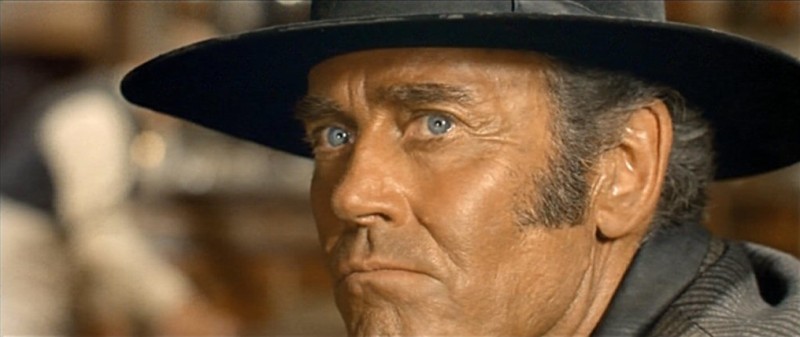
Once Upon a Time in the West (1968)

Normally I strive to be elevated in my criticism, preferring the lofty and the urbane to rank obscenities and childish adjectives. Now, however, I must resort to the only words available to me — Once Upon a Time in the West kicks fucking ass! It’s the sort of fuckin’-a good time that leaves me pleased with the world and all of its contents. If you catch me within a few hours of a screening, I just might smile in your direction. You might even hear me say that I’m glad to be alive. Sergio Leone’s 1968 masterpiece (and I use that word with complete and utter confidence) is not only the greatest Western ever made at any time, in any country, by any director, but it also ranks as one of the boldest experiments in all of cinema; a landmark motion picture of unique vision, confidence, stylistic ambition, and operatic madness.

For yes, it is madness — asking that we endure long silences, wordless glares across barren landscapes, and a story that in lesser hands would whip by in 85 minutes, and is instead stretched out to a beautiful, impossibly breathless 165. We are also asked to accept the closest thing to an American Saint in movie history, blue-eyed Henry Fonda — Young Abraham Lincoln himself — as one of the meanest sons-a-bitches to ever grace the silver screen. A man who unapologetically murders an entire family, including a wide-eyed, plucky little redhead, all for cold, hard cash and the satisfaction of having ended a life. After being lectured by the railroad magnate who hired him to perform the deed (“You were only supposed to have scared them!”) he answers, deadly serious and bereft of all human feeling, “People scare a lot easier when they’re dyin’.” If that’s not Ruthless, I don’t know what is.

Above all, Once Upon a Time in the West is a European’s twisted and insanely accurate picture of the American Way, typified by the push Westward — unchecked capital, amoral and relentless, will use any method, including murder, to secure its ends. For many, the railroad ensured prosperity and an expansion of the American Dream (which it did), but in order to finalize that much-needed goal (and only a fool would argue against it), many had to die horribly and exploitation was unavoidable. That isn’t left-wing revisionism; it is simply the truth of history. From cheap labor, to prostitution, to murderous greed, the West was vintage Americana — exactly the sort that could proclaim Americans as “touched by the hand of God” while using their own hands to slit Native American throats, rape Asian women, and shoot innocent children. I can’t imagine an America any other way, and no one is asking you to, either. We’re a barbaric, savage people and it’s about time we claim that label as our own. Sometimes it takes an outsider to hold up the mirror.
onceupon5

But just as much as that, Leone’s film is a Western about Westerns, employing shots, landscapes, and allusions that are a virtual panorama of film history. While listening to the commentary track, I was astounded to hear how frequently Leone borrowed from the masters. From John Ford to Nicholas Ray, Leone is demonstrating that it is impossible to make a great film without tipping one’s hat to those who came before. Only the arrogant and the mediocre try to pass their crap off as wholly original. But while Leone gives us pieces of the past, he transcends his teachers and proudly takes thematic risks that those men would have avoided. True enough, Ford asked questions of himself late in his career, but Leone was one of the few who dared utter in public the belief that the Western is the one true American genre because it reveals the corruption of our very soul. That’s not to say that this movie isn’t entertaining as hell and full of a joyous spirit. Leone loves filmmaking as an art unto itself; he sweeps his camera along, twists us around, and uses some of the most dramatic (and fitting) music ever composed to barrel forward with his tale.

Take the opening credits — nearly ten minutes by my clock — where three hired guns wait at a train depot for an unknown passenger to arrive. The wide screen compositions are as lush and inviting as any I’ve ever seen, and we haven’t yet visited Monument Valley. Leone takes us around the station; from water dripping on a hat, to a pesky fly bothering a napping gunslinger, to a squeaky windmill. In a sense, nothing is happening, yet the tension is almost unbearable. Most of all, we are floored by the audacity. No one speaks and no one does much of anything, yet we know a stranger will be arriving and then, well, who knows? The opening scene is a primer for all that Leone does — and does well — and should be studied at length by all those who believe that fast cuts and blaring action are necessary to thrill an audience. It is telling that Leone cites Akira Kurosawa and Yasujiro Ozu as major influences in that they are all willing to let scenes play as they must without rushing to the next dramatic development.
onceupon6

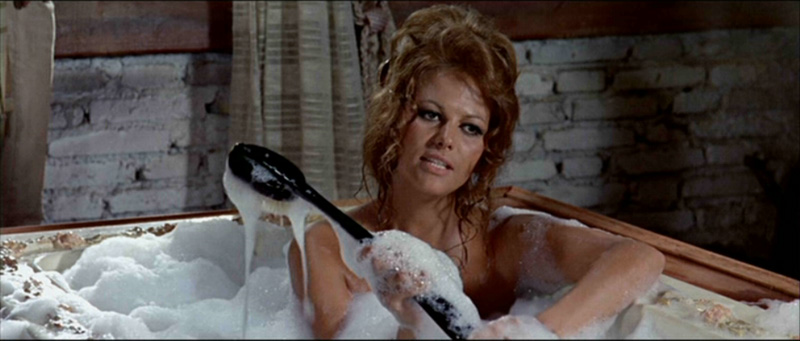
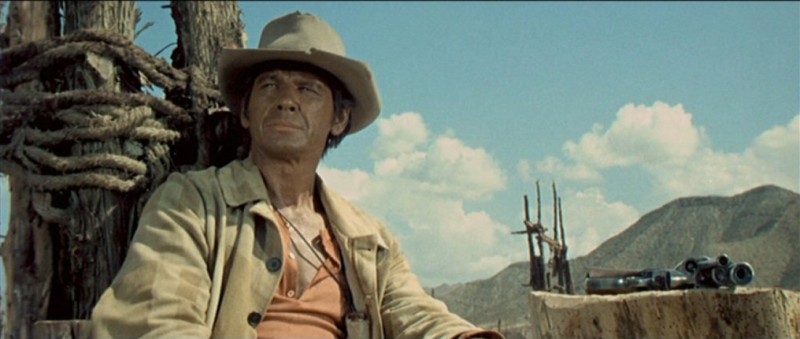
And then there’s the cast: Fonda, Jason Robards, Charles Bronson, Claudia Cardinale, Woody Strode, Jack Elam, and dozens of character actors with incomparable faces. Perhaps these are “types” in the classic Western sense (the loner seeking revenge, the ex-whore who marries for security only to lose her husband to violence, the millionaire who punishes others to compensate for his crippling paralysis), but Leone never claimed to be working against the rules of the game; only tweeking them a bit to reach a larger purpose. And yes, as I said earlier, it is operatic, and as such must adhere to those conventions as well. But there are no real winners and losers in this fight, and that is what elevates Leone’s work.

I can only close with a sigh of contentment as I remember the style. It could be argued that there has never been another film that is so reliant on style, yet also manages to show us a deeper meanings and leave us with a better understanding. Leone has no problem rubbing our noses in his craft, but for once there is more to it than that, although this is one of the few times I would argue in favor of style alone. I watched with commentary and yet was transfixed by the silent images, and I am sure I could watch with the sound off completely. And then I’d watch it again with the sound on and no picture. Regardless of what one chooses, this is a film that holds rewards on numerous levels and could be watched again and again without a shred of bored familiarity. My only sadness comes from not seeing it on the big screen, although such a privilege might ruin me forever. After that, what could ever really measure up? And would ever have the nerve to try?

Quotes and one-liners:

Did you bring a horse for me? -Harmonica
⦁ Well…It looks like…It looks like we’re shy one horse. -Snaky
⦁  (Shaking head) You brought two too many. -Harmonica
⦁ Wobbles, how can you trust a man that wears both a belt and suspenders? A Man can’t even trust his own pants. -Frank
⦁ Tell me, was it necessary that you kill all of them? I only told you to scare them! -Morton
⦁ People scare a lot better when they’re dyin’ -Frank
⦁ The future don’t matter to us. Nothing matters now – not the land, not the money, not the woman. I came here to see you, ’cause I know that now you’ll tell me what you’re after. -Frank
⦁ Only at the point of dying. -Harmonica
⦁ Inside the dusters there were 3 men. Inside the men there were 3 bullets. -Harmonica
⦁ Let’s have a good look at you. Hey. Mr. Choo-Choo. It’s easy to find you. Bastard! I don’t have to kill you now. You leave a slime behind you like a snail. Two beautiful shiny rails. -Cheyenne
⦁ You know Wobbles…I’m kinda mad at you. (Beats the Hell out of Wobbles) -Harmonica
⦁ He not only plays, he can shoot, too. -Cheyenne


Posted

in

, ,

by

Tags:

Comments

9 responses to “Once Upon a Time in the West (1968)”

  1. Goat Avatar
    Goat

    This is my #1 film of all time.

  2.  Avatar
    Anonymous

    Is it operatic? I think it’s a ballet.

    Two men, dancing around a shared history. It’s a complex dance, but also a simple one. “Nothing matters now,” but nothing ever did. The rest is a distraction, a well told, beautifully filmed, amazingly scored distraction but..

    It’s a ballet and nothing else matters.

    Your quotes cut off the part of the conversation that proves this.

    “Only at the point of dying.”
    “I know.”

    Two simple words, possibly the best two word sentence in cinema history. Not the script, the delivery. Weariness, understanding, acceptance, inevitability and expectation, shared with calm certainty.

    The two hours beforehand? That was Leone letting you know why those two words matters.

  3. Barbara Patrick Avatar
    Barbara Patrick

    TCM was showing this film late on a Sunday night. Westerns are not my forte. It was Henry Fonda that drew my attention. As expected the ending was typical western. (Two men facing off at a shootout. The revelation of the harmonica was the most I tersting part. I strongly disagree with the remark of the reviewer that the violence and moral decay Typifies the American way. It is obvious this comes from todays lleftist perspective.

  4. Keith Evans Avatar
    Keith Evans

    The only problem I had with this film is that every character had a perfect set of shining white teeth!!! With the incredibly close up shots of faces these brilliant white teeth were just too much for me!! Nobody in the old wild West would have had teeth like that in fact most probably had few teeth at all!!! For me it was a glaring error!!

  5. Susan Corus Avatar
    Susan Corus

    The film is brilliant. Casting, location, storyline, music and dialogue … even when there isn’t any. The pace is slow, but so is real life sometimes. I first saw this in 1970. I was just some dumb self-absorbed hippy living in Santa Monica. We would go to the Fox theater and see a double feature for fifty cents. Hey, that’s about all we had. The main feature was why we went and I don’t recall what it was. It was OUATITW that remained with me.

    The first line that resonated with me was delivered by Roberts when he tells Bronson, “don’t watch me die.” I remember telling my mother when I was a young teen that I didn’t want anyone around when I breathed my last breath. I’m 76 now and I still don’t. Bronson on the other hand helped me to grow up. This happened in stages.

    At 20 I didn’t have any problem with retribution/vengeance. What comes around goes around, turnabout is fair play and if you can dish it out you had better be able to take it. I stood on that until I was in my 50’s. Then either God found me or I rediscovered Him. Our maker says vengeance is HIS. Well, that’s annoying but still a fact. After a closer study of the word I learned that God stands on JUSTICE. So what is really happening here?

    Harmonica is a man of few words, slow to anger giving away little of himself. So was a man that speaks in the four gospels. Don’t get me wrong here, I am NOT equating one with the other. I am simply saying it looks like he (Bronson) was taking a page from a major book. Maybe we all should. Our tongue does tend to get us in deep trouble.

    He moves at a steady and slow pace. He knows where he is going and why. He is disciplined, well trained and has an end game. Most of us do, but it is the discipline that we often lack. So my question is this. Clever can be synonymous with smart, but not always. Vengeance can be righteousness/justice, but that is not always the truth of the heart. So, who was Harmonica? Was he right or wrong?

    Well, considering how cold and cruel Frank was. Did Harmonica stop his journey to more death and destruction? YES! Was that a good thing? Now that is a silly question.

    In short, a totally powerful film. It speaks volumes often by saying nothing. Gee, I hope I can get better at that with the time I have left.

    Note: The music for this film was a 33-record album. I know because Once Upon a Time in the 1970’s, I owned it. Good luck trying to locate it.

    1. Goat Avatar
      Goat

      Thank you for your excellent comment and analysis. I will make sure that Matt sees this.

  6. Susan Corus Avatar
    Susan Corus

    I do not know who Matt is. I never thought anyone would give a hoot about what I posted. Thank you for thinking it was worth anything. For me it was a journey through the past darkly. An interesting memory of an experience that was astounding for me and those I was with at the time. Sadly, many of them are no longer with me. No one left the Fox that night without forethought. I could say more but less words often speak volumes. In short, a couple of them still had their minds somewhere between Da Nang and Saigon. I was too stupid to ask at the time, but I have to wonder now, at the end of my days, if they too didn’t question … what they did … was it vengeance or was it justice? I pray they got to the right place. Again … a well-crafted film that to me will always be timeless.

    1. Goat Avatar
      Goat

      Matt Cale wrote the review.

    2. Goat Avatar
      Goat

      Looks like you have some stories to tell. If you would like to contribute an article to Ruthless, send it to me at newruthlessauthors@gmail.com
      or ruthlessreviews@yahoo.com. If not, that is fine too. Thanks for your interest in Ruthless Reviews.

Leave a Reply